
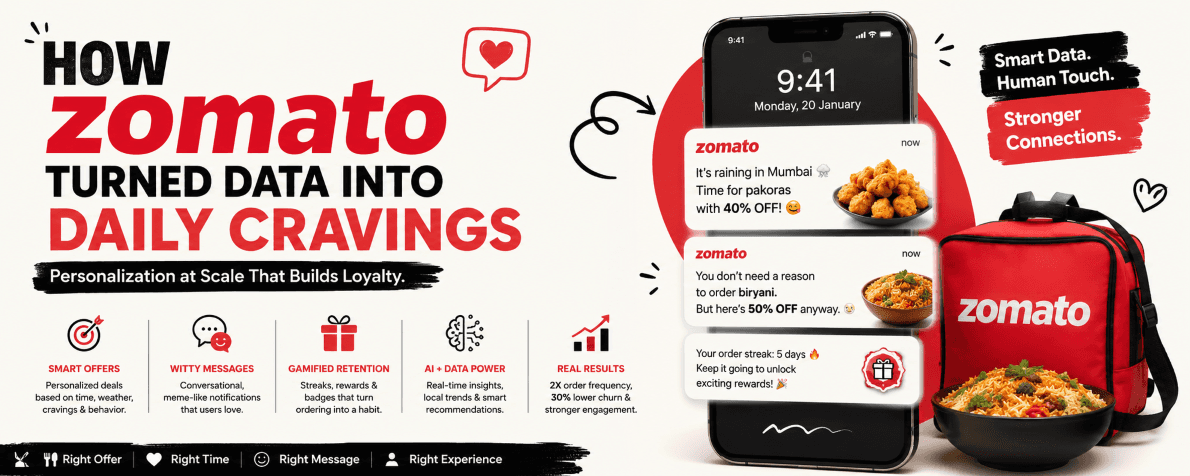
How Zomato Turned Data Into Daily Cravings Through Personalization at Scale
There was a time when food delivery apps competed mainly on discounts.
Every platform offered coupons, cashback, and free delivery.
But as competition increased, discounts alone stopped creating loyalty.
Customers would simply switch to whichever app offered the best deal that day.
That’s when Zomato realized something important:
People don’t just order food because they’re hungry.
They order based on mood, cravings, weather, habits, emotions, and convenience.
And if a brand could understand those moments better than anyone else, it could become part of a customer’s daily routine.
That insight became the foundation of Zomato’s “Daily Value Deals” strategy.
The Objective
Zomato wanted to transform occasional users into daily customers.
The goals were clear:
• Increase daily order frequency
• Improve app engagement and retention
• Reduce customer churn in a highly competitive market
• Build a brand personality that felt human, local, and relatable
Instead of relying only on paid ads, Zomato focused on making the app experience itself more personalized and addictive.
Turning Data Into Delight
Zomato understood that personalization works only when it feels natural — not forced.
So the company built a strategy that combined data, emotion, and humor.
1. Dynamic Offers Based on User Behavior
The company introduced “Daily Value Deals” — personalized offers that changed based on:
• Time of day
• Weather conditions
• Cuisine preferences
• Past order history
• Local food trends
For example:
“It’s raining in Mumbai — time for pakoras with 40% off.”
Instead of generic promotions, Zomato connected food recommendations with real-life moments and cravings.
The offers felt timely, relevant, and surprisingly human.
2. Conversational & Witty Notifications
Most app notifications sound robotic.
Zomato chose a completely different approach.
The brand started sending playful, meme-like notifications that sounded more like social media banter than marketing copy.
For example:
“You don’t need a reason to order biryani. But here’s 50% off anyway.”
These notifications didn’t just drive clicks.
They entertained people.
In fact, many Zomato notifications became viral social media posts themselves — giving the brand free organic visibility.
3. Gamified Retention
Zomato also introduced streaks, rewards, and badges to encourage repeat orders.
This created a habit loop:
• Open the app daily
• Unlock rewards
• Maintain streaks
• Feel motivated to return again
The experience felt less transactional and more interactive.
Execution at Scale
What made the campaign impressive wasn’t just creativity.
It was the scale at which personalization happened.
Zomato combined:
• AI-driven recommendation systems
• Real-time data analysis
• Localized language adaptation
• Trend-based messaging
Notifications and offers were customized across multiple Indian languages including Hindi, Tamil, and Bengali.
The brand also reacted quickly to:
• Festivals
• Cricket matches
• Viral memes
• Local trends
This made Zomato feel culturally aware and deeply connected to everyday Indian life.
And importantly, the campaign relied more on smart copywriting and personalization than massive advertising budgets.
The Results
The impact was significant.
Zomato reportedly achieved:
• 2× increase in order frequency across key metro cities
• 30% reduction in repeat-customer churn
• Stronger app retention and engagement metrics
• Viral social media visibility through notification screenshots and memes
The campaign proved that clever personalization can outperform traditional advertising when executed correctly.
The Real Lesson
Zomato’s success highlights an important truth about modern marketing:
Personalization is not about inserting someone’s name into an email.
It’s about understanding people deeply enough to make relevance feel effortless.
The campaign worked because it blended:
• Data with emotion
• Technology with humor
• Analytics with human behavior
Data alone feels robotic.
Emotion alone lacks precision.
But when brands combine both effectively, they stop feeling like apps — and start becoming part of people’s daily lives.
That’s exactly what Zomato achieved.
And in today’s attention economy, becoming a daily habit is one of the strongest competitive advantages a brand can build.